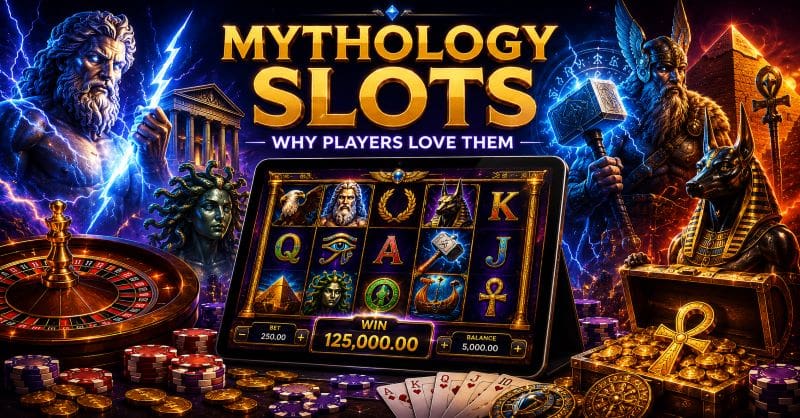
Slot machines can take a long time, and during that time many players see a pattern that is rarely spoken about aloud: the ones with gods on them seem to pay differently than others. Not numerically (payout math), but as far as how long people will play at a machine. I’ve seen it happen countless times on casino floors: somebody playing a Zeus machine for 45 minutes straight, with lightning bolts lighting up the screen; meanwhile the Zeus neighbor, with just normal fruit symbols, cannot retain anybody’s focus beyond 10 spins.
That is not a coincidence. And it’s not purely due to graphics budget (although that helps). It is about mythology-based slots providing an escape into mythological worlds that few other themes provide therefore mythology-based slots continue to attract players’ attention decade after decade while other themes may come and go. When asked why mythology-based slot games tend to have higher-than-average engagement numbers compared to other types of games a typical response from game designers would include: “Players are coming in with existing interest.” Players do not need an explainer screen to understand that Zeus strikes lightning, Medusa turns people into statues, or that Anubis is involved in determining whether mortals live or die.
That knowledge was developed decades ago through classrooms, comic books, novels (e.g., Percy Jackson) video games (e.g., God of War), movies (Marvel) etc. Developers enter a space that has already been furnished and that changes the entire cost structure of developing a slot. Why studios prefer to develop mythology-based slots Over the last two decades, there has been an increase in popularity among both studios and players alike in creating slot machines based on mythologies. The primary reason for this increased interest lies within the economic benefits of using previously created universes (i.e., Greek, Norse, Egyptian, Asian etc.) as opposed to creating new fictional universes for slot games.
Creating a new fictional universe for a slot game requires significant financial and creative investment, primarily due to the risk associated with educating the player base regarding the rules of the fictional universe prior to establishing player loyalty/engagement. Mythology does not require this education. Greek mythology, Norse mythology, Egyptian mythology, and a variety of Asian folk stories provide developers with large pre-built casts of characters, their conflicts, and visual metaphors. In addition, these cast lists have been populated with character personalities e.g., Thor is depicted as strong/powerful whereas Loki is portrayed as cunning/trickster. Therefore, designers do not have to create three screens of lore to explain why Thor’s hammer is powerful. Everyone already understands this.
Furthermore, this is the main reason that the allure of gods and myths in slots persists longer than current pop culture trends. Pop culture themes are inherently connected to films/movies/TV shows therefore they have limited shelf lives (months) and quickly become outdated. Themes based on mythology are not dependent upon pop culture fads. Zeus was popular in 1995. He is popular today. It is likely that he will continue to headline new slot machine releases for another decade. Long term catalog value matters to studios as they plan for future product offerings. According to industry tracking and reporting firms (including data provided by the European Gaming & Betting Association and independent research groups e.g., EM Learning) a substantial portion of new slot releases (estimated to be approximately 25% of all new slot releases annually) are based on mythological themes in some fashion.
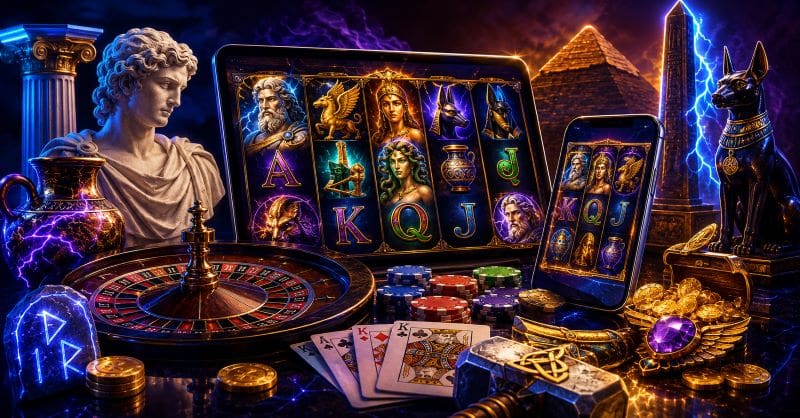
Additionally, estimates exist suggesting that nearly 40% of all slot machine titles currently available contain mythological elements. While the actual percentages depend on definitions and sources used the overall trend is evident: regardless of location or type of casino, mythologically-themed slots remain consistently popular. Psychology behind player attraction to mythology-based slots. On top of the obvious market forces exists a deeper psychological factor that should not be dismissed as mere marketing rhetoric. Mythology slots allow players to escape into mythological realms more effectively than virtually any other theme. For example, players typically do not encounter lightning-throwing kings of the gods or magical hammers that only those deemed worthy can wield during everyday life.
Twenty minutes spent playing a Thor/Odin themed game is equivalent to a small-scale escape from reality into a realm where power fantasies serve as the sole objective and players are allowed to temporarily join a group of legendary figures rather than deal with traffic or an overflowing inbox. Most mythology-based slots also follow some version of the hero’s journey format regardless of whether the player consciously recognizes this. Examples include: overcoming great obstacles; obtaining favor from the gods through perseverance; etc. These formats have served as a basis for thousands of years of storytelling and are utilized freely by slot developers because they work. A bonus round framed as “demonstrate your worthiness to Odin’s Hall” elicits more emotional response than a bonus round framed as “three scatter symbols caused you to trigger.”
Regardless of whether mechanically these two examples are functionally identical the former provides emotional context lacking in the latter. The emotional bond formed with myths derived from universal concepts such as love, war, betrayal, and death creates a perceived level of consequence that plain numerical games lack. Additionally, nostalgia for legendary tales plays an additional quiet but lasting role in this phenomenon as well. Many adult players initially encountered these characters as children through books/cartoons/school units on ancient civilizations long before online casinos existed.
Zeus, Thor, Medusa: a cast that everybody knows
One aspect that greatly contributes to mythology being able to serve as a sustainable slot category is the enormity and familiarity of its cast of characters. Greek mythology alone provides Zeus, Medusa, Mount Olympus and countless other backdrops and settings for developers. Norse mythology provides Thor, Odin, Loki and Valhalla, all with unique characteristics that translate directly into game mechanics (Loki lends himself naturally to unpredictable bonus features).
Egyptian mythology, closely related to Ancient Egypt slots, brings Ra, Anubis, Cleopatra and iconic imagery relating to pyramids instantly recognizable in a thumbnail-sized lobby icon. Although Merlin and King Arthurian legends appear frequently as folklore adjacent to mythology, proper Asian Folklore represents an increasing source for mythological elements and includes dragons, celestial warriors and distinct visual representations. As stated before each mythological tradition offers its own unique visual representation and game mechanic fingerprints. As such, it is helpful to break these down explicitly since they matter in regards to how a game functions and feels.
Titles featuring Greek mythology tend to utilize marble columns, lightning effects and Mount Olympus backdrops with Zeus/Medusa serving as the most valuable symbols. Titles featuring Norse mythology tend towards icy, stormy backgrounds, runes as scatter symbols and Thor’s hammer/Odin’s raven as expanding wilds or repeating motifs. Titles based on Egyptian mythology employ sand-gold palettes and pyramids/ankh symbols with Ra/Anubis usually producing larger bonus features. Titles employing Asian Folk Story elements employ dragon/lantern/jade color schemes; mythical creatures replace gods in other traditions.
Storytelling, sound and why these games feel cinematic
In addition to the market advantages offered by utilizing mythology in slot games there are also a host of creative advantages. Specifically: a growing emphasis among slot developers towards telling stories within their games has greatly contributed to the enduring popularity of slot games based on mythology given that myths represent perhaps some of the best-prewritten narratives available to draw upon.
Conflicts, epic journeys, sibling/brother rivalry leading to betrayal or murder these are narrative forms that have been engaging audiences for millennia and thus represent attractive frameworks for slot developers looking to engage their audience. Utilizing dramatic conflict/narratives borrowed from film/games rather than those from traditional slot machine designs serves to enhance the emotional connection felt by players towards the game world and thus enhances their willingness to continue playing. Additional support for this emotional connection stems from the visual/audio layers employed within these games.
Flashing lightning/thunder effects during a Zeus win; richly detailed backdrops for ancient temples; animated god-character interactions designed to produce realistic swinging motion when Thor wields his hammer; ambient music composed using choir/orchestral arrangements rather than generic casino jingle-style tracks all contribute to an immersive experience that draws players in immediately upon clicking into the game and continues to draw them in throughout subsequent minutes of gameplay.
Godlike abilities lend themselves surprisingly well to slot mechanics
Another perspective that receives relatively little discussion: mythology is not merely a suitable coat-of-paint applied over arbitrary slot mechanics rather it is capable of explaining the mechanics in ways that render them less arbitrary. Expanding wilds presented as a god spreading his divine influence across the reels; multiplier triggers described as a hero’s magical ability activating; etc., all feel like events occurring for a purpose rather than randomly selected combinations of numbers.
Symbolic representation of legendary artifacts (Thor’s Hammer); treasure-hunting relics; magical swords/enchanted bows; etc., provide natural high-value symbols because they are symbolic representations of importance within mythology — they are plot devices. Artifact-bonus rewards fit seamlessly into stories where relics/artifacts are crucial components of the narrative thus, finding one on the reels does not feel like discovering an arbitrary feature of the slot machine; rather it feels like a reward from the story itself.
Progressive jackpots representing mythological treasures; free-spins with multipliers; bonus rounds centered around specific myths; etc., rely on the same strategy: presenting mathematical features inherent to slot machines as manifestations of divine action.
Retention numbers indicate cautious optimism
It is worthwhile being cautious when assessing retention data relative to this topic as retention data varies significantly depending on operator, market conditions, and methodology employed to collect metrics. No individual source should be viewed as authoritative on this subject. However, across numerous reports/industry commentaries, there appears to be a consistent trend indicating that mythologically-themed titles exhibit longer session lengths than non-narratively driven title averages by some accounts ranging from 20-25% greater length per session; and several popular titles exhibiting session lengths exceeding 45 minutes; i.e., lengthy periods of play by slot machine standards.
Retention metrics also demonstrate similarly positive results for mythologically-themed titles versus non-narrative titles operating in comparable volatility brackets. Treat these findings as indicative of general trends across industries rather than universally applicable figures due to disparate methodologies employed across studies/reports. The fact remains that studios continually release new mythology-based slot titles every year including multiple new mythology-based slot games entering development prior to 2026, covering a wide array of subjects from reimagined versions of Zeus/Odin/other Greek/Norse gods/legends … to lesser-explored areas like Asian folklore which are receiving significantly more development dollars in recent years than ever before. Developers invest in categories with demonstrated continued player engagement regardless of methodology used to measure that engagement